
[🇬🇧] The aerospace war between Iran vs the USA and Israel in one drawing

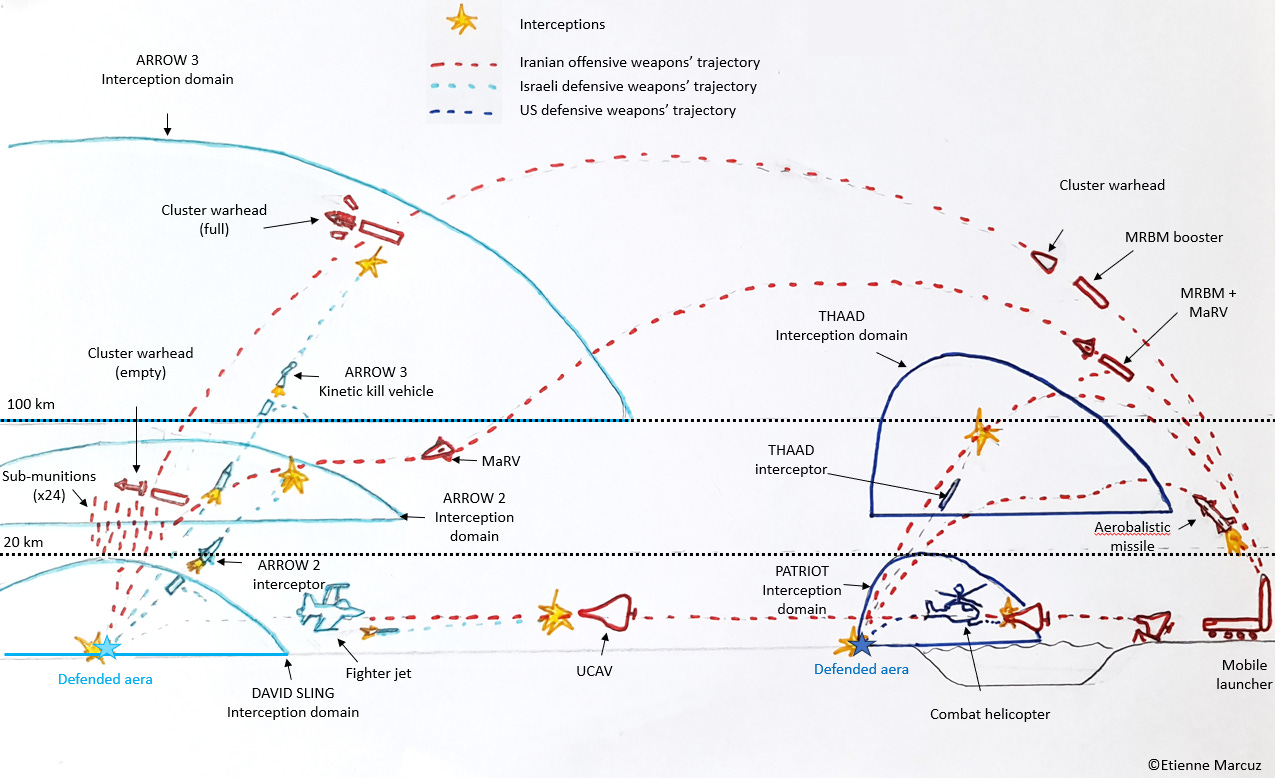
Since the start of the new war raging in the Middle East, several journalists have asked me how Iranian ballistic and drone attacks work, as well as the U.S. and Israeli missile and drone defense systems.
So, I picked up my markers and pencil to draw a rough but, I hope, educational sketch to explain what’s happening above the heads of the people in the Arab-Persian Gulf region.
This is obviously an extremely complex subject, both technologically and operationally. There are approximations, both to make the topic somewhat understandable and because some data is not publicly available.
On the Iranian side, I chose to represent five types of vectors:
A short-range ballistic missile (SRBM—unfortunately not drawn, but the trajectory is shown)
A short-range aeroballistic missile (or maneuvering ballistic missile)
A medium-range ballistic missile (MRBM) with a maneuverable reentry vehicle (MaRV)
An MRBM with submunitions
An attack drone like the Shahed.
On the U.S. and Israeli side, I represented the multilayered missile defense systems.
United States:
THAAD—high endoatmospheric/low exoatmospheric (area defense)—interception ceiling probably between 30–40 km altitude up to over 100 km
PATRIOT—low endoatmospheric (terminal defense)—interception ceiling probably below 20 km altitude
Israel:
ARROW 3—exoatmospheric (territorial defense)—interception ceiling above 100 km (in space)
ARROW 2—high endoatmospheric (area defense)—interception ceiling probably between ~30–40 km and ~80 km altitude, though data is not public
DAVID’S SLING—low endoatmospheric (terminal defense)—interception ceiling probably below 20 km altitude
Note that U.S. defensive system launchers are directional (facing the threat), while Israeli launchers are omnidirectional (vertical launch), hence the larger bubble, even though in reality Israeli radars are also oriented toward the threat.
For drones, most interceptions are carried out by fighter jets or helicopters far upstream of the defended area. In case of failure, there are very short-range defense systems, but that would have overloaded the drawing.
The idea is to show the strengths and weaknesses of each system against the opposing defense.
For example, an MRBM with submunitions will be vulnerable to exoatmospheric interception (ARROW 3), but the release of submunitions makes it almost completely immune to terminal defense (PATRIOT/David’s Sling). Conversely, an aeroballistic/maneuvering missile or a MaRV will be largely immune to exoatmospheric interception but vulnerable to high endoatmospheric and terminal defenses, with vulnerability increasing with the number of maneuvers performed by the vector.
Finally, I did not include the Iron Dome, which is mainly designed to intercept short and very short-range rockets and thus plays only a marginal role in this conflict (against Hezbollah).