
[🇬🇧] Why a Speech on Nuclear Deterrence ?

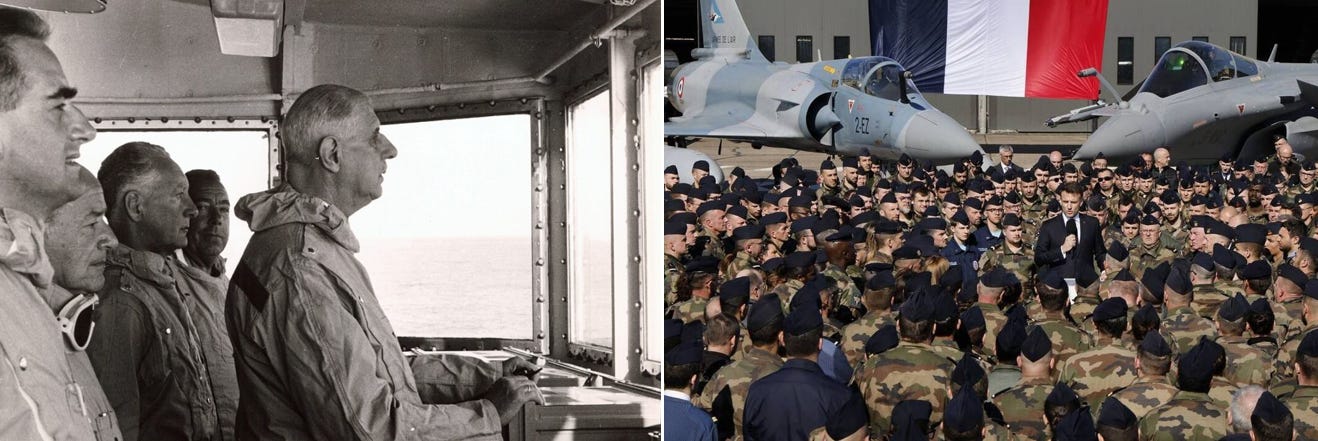
The highly anticipated speech by the President of the Republic on nuclear deterrence, during which significant announcements are expected, is part of a long tradition of successive adaptations to both the doctrine and the posture of France’s nuclear forces. It also comes at a time of increasing geopolitical instability, as evidenced by the launch this Saturday of the joint US-Israeli war against Iran.
Historical Continuity
This speech is in direct continuity with the traditions of the Fifth Republic: each president, during their term, delivers a speech solely dedicated to their vision of nuclear deterrence. The delivery of this speech—not the pre-written text—becomes France’s official nuclear doctrine. It is the sole prerogative of the President to decide when and where this speech will take place. They may choose to deliver it early in their term, for example if their vision significantly differs from that of their predecessor, or later, after becoming fully acquainted with the highly strategic and complex concepts and practices of this domain. In the event of re-election, the second speech tends to occur late in the term:
François Mitterrand on May 5, 1994—almost exactly one year before the presidential election;
Jacques Chirac on January 19, 2006—one year and four months before the election.
Thus, the timing of Emmanuel Macron’s upcoming speech is nothing exceptional. It is important to note that, barring a major upheaval—particularly in terms of capabilities, such as the abandonment of a component—announcements are reversible as soon as a new president takes office.
A Collective Endeavor
Ahead of the speech, the President provides guidance and then relies on long-serving state officials involved in nuclear deterrence, particularly from the Military Applications Directorate of the Atomic Energy Commission (CEA-DAM), the Directorate General for International Relations and Strategy (DGRIS) of the Ministry of the Armed Forces, the Ministry for Europe and Foreign Affairs, the Nuclear Forces Division of the Armed Forces General Staff (EMA-FN), and the President’s own Military Staff (EMP). More than the speech of one individual, it is therefore a collective work made concrete by the address of the people’s representative, elected every five years by universal direct suffrage, which confers the legitimacy to order a nuclear strike in the name of the Nation.
While the speech may have a slight “political hue,” in practice the doctrine primarily responds to strategic needs independent of the individual in office, as its purpose is to preserve the sovereignty of the French Nation against any potential state adversary under all circumstances. This requires regular adaptation of both doctrine and posture to align with the geostrategic context of the time.
A Doctrine and Posture Largely Unchanged Since 2008
Although each presidential term features a speech on deterrence, only marginal changes have been made since March 21, 2008, the date of Nicolas Sarkozy’s speech in which he announced a one-third reduction in the size of the Air Strategic Forces (FAS), one of the two permanent components of France’s nuclear deterrent. Since that address, the FAS have been reduced to two squadrons dedicated to nuclear operations, down from three. It was also on this occasion that the decision was made to reduce the French arsenal to fewer than 300 nuclear warheads.
This reduction was driven by both a constrained budgetary context, at the onset of a global financial crisis, and a relatively “favorable” security environment, in which the main threat to France was terrorism—against which nuclear deterrence was of little use. The primary nuclear threat came from proliferating states, notably North Korea and Iran, against which a reduced force posture could be seen as sufficient. At the time, Russia and the United States were engaged in discussions to limit their strategic arsenals, culminating in the signing of the New START Treaty in 2010, while China had not yet begun its push to develop an arsenal equivalent to the other two major powers.
For these reasons, many voices in France at the time called for the outright abandonment of the air-based nuclear component (CNA), deemed redundant with the sea-based component (CNO), which alone could guarantee massive retaliation under all circumstances (a point to be addressed in a future article).
Geostrategic Upheavals
While the upcoming speech on March 2 is indeed part of this historical continuity, it comes at a time of major geostrategic upheavals in Europe and globally, even since Emmanuel Macron’s previous speech on February 7, 2020, during his first term.
The most notable development is undoubtedly the return of high-intensity warfare to European soil, following Russia’s invasion of Ukraine in February 2022, after the “warning shot” of the annexation of Crimea in 2014. In this war, Russian nuclear coercion, or aggressive sanctuarization, has played a significant role, compelling European leaders and populations to re-engage with nuclear dialectics, largely forgotten since the 1990s. Since the outbreak of this war, Russia has also deployed nuclear weapons on foreign soil, in Belarus, and forged a strategic alliance with North Korea, another nuclear power, which has been marked by the deployment of North Korean troops to the Ukrainian front—and thus to Europe.
The re-election of D. Trump in November 2024 and the subsequent hostile actions have also served as a painful wake-up call for many European states, which have learned the hard way that the protection of another state is never guaranteed, especially if that state is on another continent. France, as Europe’s only autonomous and independent nuclear power, has thus found itself thrust into the role of potential ultimate protector of the continent in the event of US disengagement—a scenario not yet realized, but one that has raised expectations among an increasing number of its allies.
In addition to these two major events for Europe, several high-intensity conflicts have involved one or more nuclear powers (Israel/Iran, India/Pakistan, Iran/Pakistan, Russia/Ukraine). During these conflicts, nuclear-armed states have sometimes suffered massive conventional strikes, including ballistic attacks, or even the invasion of part of their territory (such as Russia’s Kursk region). On certain occasions, the nuclear forces of these countries have been directly targeted, as in the Ukrainian “Spider Web” attack on Russian strategic aviation bases. These events have starkly demonstrated that nuclear weapons are not the totem of immunity some imagined, but only protect their possessor against the most serious attacks that directly threaten the survival of the state.
Finally, the progressive abandonment of various arms control mechanisms (ABM Treaty in 2002, INF Treaty in 2019, and New START in 2026) has marked the end of an era of declining nuclear arsenals for almost all nuclear powers, with the notable exception, until now, of France. Several of these powers, including France’s main strategic competitors, are simultaneously developing strategic missile defense capabilities that could, in the still relatively distant future, limit the effects of a nuclear retaliatory strike.
A Legitimate and Necessary Speech
In conclusion, this speech is indeed part of a historical framework that began under de Gaulle. But above all, it responds to a strategic need to adapt French nuclear deterrence to an era of growing global instability, at a time when the specter of large-scale war on European soil has not been so great since the end of the Cold War. Russia, the United States, and the United Kingdom have all updated their doctrines and postures to account for these upheavals. It is now time for France to do the same, lest it find itself without the means to deter competitors from threatening its vital interests.